

India’s tourism ambitions stand at a dangerous precipice. For too long, our approach to developing new destinations—even in the face of mounting over-tourism—has been to simply replicate a broken template. We pour billions into ‘new’ attractions, imposing top-down narratives, building infrastructure primarily for visitors, and tragically, converting the authentic lives of our communities into mere service-industry roles or curated performances. This blueprint for yesterday’s ‘success’ is fast becoming tomorrow’s ecological and cultural disaster, eroding the very soul of the places we seek to promote.
This isn’t just inefficient; it’s unjust. The most egregious consequence of this template-driven expansion is the profound and consistent skewing of value appropriation, heavily favoring organized players over the communities whose heritage forms the very bedrock of the appeal.

This phenomenon, known as tourism leakage, occurs when money spent by tourists leaves the local economy, primarily through imported goods, foreign-owned businesses, and international intermediaries. While investments flow, a staggering up to 80% of tourist revenue can leak out of local economies in such models, bypassing the very people whose culture and effort make the experience possible. Certain estimates of tourism leakage in Third World countries range from 80% in the Caribbean to 40% in India. Check the link for source of data).
This imbalance doesn’t just deprive locals economically; it service-ifies their identity, reducing their vibrant way of life to a performance meant solely to “welcome” and “entertain” guests. This unsustainable equilibrium is failing both our communities and our national potential.
The answer isn’t another quick fix. It lies in a “Soulful Destinations Blueprint”: a comprehensive, blended approach to placemaking and experience creation that redefines India’s tourism value proposition. This blueprint offers a transformative path towards inclusive development, unlocking a projected ₹500 billion experience economy, and creating compelling value for all stakeholders, from policymakers to diverse professionals, and most importantly, empowering local communities to reclaim agency and equitable ownership in their own story.
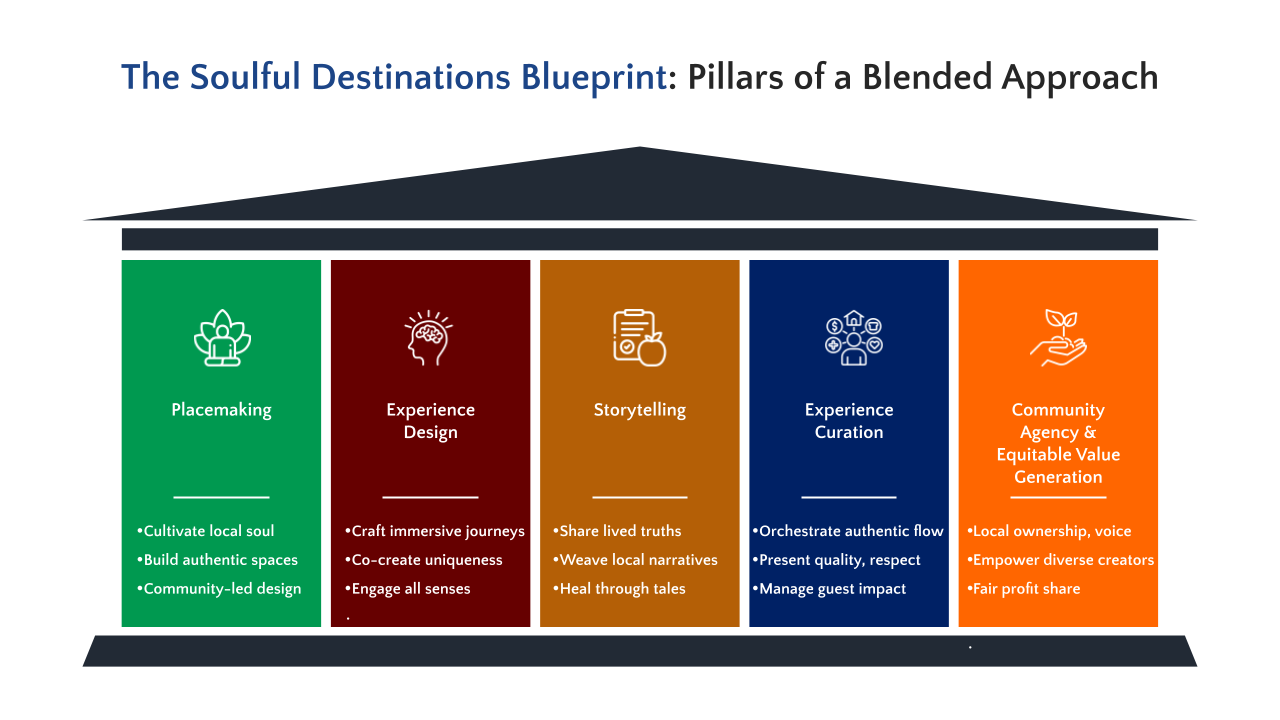
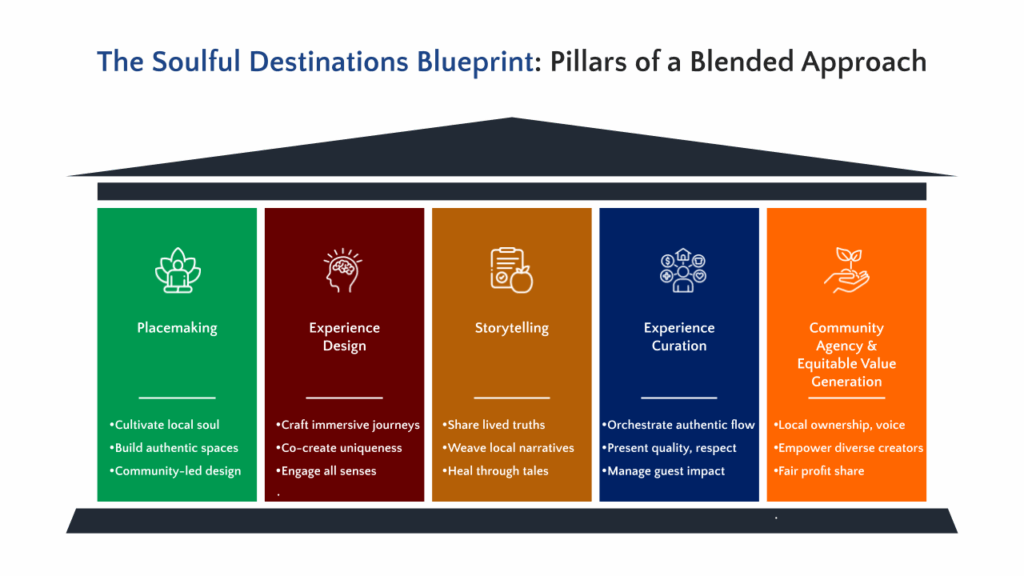
The Soulful Destinations Blueprint: Pillars of a Blended Approach
This blueprint is built upon five interconnected strategic pillars, designed to foster a tourism ecosystem where the spirit of the place is not just preserved, but actively celebrated and cultivated.
1. Placemaking as the Foundation: Cultivating the Spirit of Place
At its core, placemaking is about intrinsically shaping spaces that breathe local identity, memory, and culture, going far beyond mere construction. It involves deep listening to what a community truly desires for its environment and future. Policymakers must champion frameworks that prioritize vernacular design, integrate local ecosystems, and ensure infrastructure serves residents first.
Strategic Integration: Local communities are not just passive recipients of development but are engaged as the intrinsic custodians and co-designers of their spaces. Artisans, like India’s Vishwakarma communities—carpenters, masons, sculptors, blacksmiths, toolmakers—possess a “placemaking intuition honed over generations.” Their historical expertise in crafting India’s temples, homes, and symbolic aesthetics is invaluable. Imagine this intuition applied to shaping eco-retreats, heritage villages, and public spaces that resonate with genuine local character, moving beyond imported designs to truly indigenous aesthetics.
2. Experience Design: Crafting Immersive & Meaningful Journeys
Experience design in tourism is the art of creating multi-sensory, interactive engagements that immerse travelers in local life and culture, fostering a deeper connection than passive sightseeing. It’s about crafting journeys that are authentic, respectful, and contribute positively to both the visitor and the visited.
Strategic Integration: Local artisans and professionals are uniquely positioned to become experience designers themselves. Take Mohanan, a carpenter from Thrissur, who dreams of “blending Kerala’s traditional designs with modern wellness concepts—a space where travelers can find peace and culture in one breath.” This vision exemplifies how local skills can directly shape traveler experiences. From crafting bespoke wooden cottages for eco-retreats to designing interactive cultural workshops and heritage homestays, artisans transform from mere laborers to co-creators of immersive, high-value experiences that redefine travel beyond transactions.
3. Storytelling: Weaving Authentic Narratives into the Fabric of Place
True value in travel lies in the untold stories and lived realities of a destination. Strategic storytelling moves beyond generic marketing brochures to unearth and share authentic local narratives, empowering communities to define and express their own identities. This allows visitors to truly understand “what they have lost” and “what they have preserved.” As Prakash P. Gopinath, Bicycle Mayor Trivandrum, Kerala, Co-Founder of Shecycling (A Nationwide Cycle Literacy Campaign), and a former Indian Railways professional underscores, “stories are powerful—they carry truth, memory, meaning. They’re not just entertainment; they heal.”
Strategic Integration: Communities become the primary narrators of their own heritage. Artisans, in particular, become narrative custodians, infusing their designs with local motifs, historical context, and the personal journeys of their craft. Consider Jaipur mason Ramesh, who laments, “I’ve built homes for 20 years, but I want to create spaces that tell our story.” This blueprint empowers him and countless others to do just that. Policymakers can support platforms for oral histories, community-led cultural tours, and artistic collaborations that allow these authentic stories to become integral to the visitor experience, fostering genuine empathy and connection.
4. Experience Curation: Orchestrating Quality, Authenticity, Flow & Personalization
Experience curation involves thoughtfully selecting, sequencing, and presenting the elements of a place and its culture to maximize value for both visitors and hosts, while meticulously preserving the sanctity and peace of the locale. This strategic role is crucial for managing visitor flow, setting clear boundaries, ensuring respectful interactions, and critically, personalizing the journey for each traveler.
Strategic Integration: Local entrepreneurs and cultural practitioners can evolve into skilled experience curators. They can design and manage authentic artisan trails, bespoke craft workshops, responsible homestay networks, and culturally sensitive festivals that are both enriching for visitors and sustainable for the community. The Garhwal village model Prakash highlighted—where “tourists are asked to deposit alcohol or intoxicants before entering… Villagers say, ‘This is our village. If you want to live here, live like us'”—is a prime example of community-led curation that prioritizes integrity.
This pillar is significantly amplified by digital technologies, enabling a level of personalization previously unimaginable. Just as e-commerce giants like Amazon or streaming services like Netflix use AI and data analytics to recommend products or content tailored to individual preferences, similar approaches can redefine tourism. Imagine a traveler receiving real-time, hyper-personalized suggestions for local experiences based on their expressed interests, past interactions, or even real-time location. Digital platforms, built with local input, can:
- Match interests: Connect travelers with niche experiences like specialized pottery workshops, rare bird-watching trails, or specific culinary masterclasses, moving beyond generic packages.
- Manage flow dynamically: Suggest less-crowded times for popular sites or offer alternative, equally rich experiences in nearby villages when a main attraction is at capacity, guided by live data.
- Empower local curators: Provide local cultural practitioners with digital tools to showcase their unique offerings, manage bookings directly, and receive feedback, enabling them to curate bespoke itineraries with efficiency.
By blending the innate curatorial wisdom of locals with smart digital tools, we can move from mass tourism to highly individualized, impactful journeys that respect local rhythm and maximize authentic engagement. This approach ensures that quality, authenticity, visitor-host harmony, and tailored experiences are actively orchestrated, creating a unique and compelling value proposition for India’s soulful destinations.
5. Community Agency & Equitable Value Generation: The Cornerstone of Sustainability
This pillar is non-negotiable. It mandates that the local community has a decisive voice and ownership in all stages—from conceptualization to operation and revenue sharing—of tourism initiatives. Without genuine community agency, even well-intentioned efforts risk becoming exploitative.
Strategic Integration: This is where the “Karigar+Creator” model becomes a powerful exemplar. Mohanan’s ascent up the Value Ladder—from a daily wage carpenter to a visionary tourism innovator, co-owning ventures with locals—demonstrates how blue-collar professionals can move from mere labor to leadership. Policies supporting micro-entrepreneurship (like PM Vishwakarma), formalizing local businesses, and creating legal frameworks for co-owned enterprises (mirroring Morocco’s community-led riads) are essential. The tragic Wayanad landslides, where exploitative top-down resort development led to immense loss, serves as a stark warning: models without true community agency are inherently unsustainable. This blueprint ensures that the significant economic value generated (a ₹100 billion rural tourism push by 2030) is distributed equitably, fostering collective ownership and empowering locals to define their own prosperity.
A National Mission: Activating the Blueprint
The “Soulful Destinations Blueprint” is more than a concept; it’s a call to action for a national mission. The opportunity is immense, not just for a ₹500 billion experience economy, but for shaping a truly inclusive and resilient Viksit Bharat.
- For Policymakers: Your role is to create the enabling ecosystem: robust frameworks, strategic funding (leveraging initiatives like PM Vishwakarma and Skill India), and regulations that explicitly prioritize community agency, vernacular design, and equitable value chains. Invest in rural incubators that foster this blended approach.
- For White-Collar Professionals: Architects, engineers, interior designers, marketers, and sales experts must embrace a new collaborative paradigm. Partner with local artisans and communities as equal co-creators, blending your technical expertise with their inherited wisdom and placemaking intuition. Explore design thinking and entrepreneurship courses that bridge this gap.
- For Artisans & Local Communities: This is your moment to reclaim your agency. Leverage your unique skills, inherent wisdom, and deep connection to your land. Organize into cooperatives, enroll in skill-building workshops, and step forward as co-creators and owners of your future. Your stories, your craft, and your way of life are the soul of India’s new tourism.
Imagine a world where every journey into India’s heartland is an opportunity for mutual enrichment, where visitors gain profound insights, and locals experience equitable value generation, cultural pride, and preserved peace of mind. This is not an idealistic dream, but a tangible reality—already emerging in places where this blended blueprint is being activated.
When we recognize that “travel should not feel like intrusion,” but rather “feel like homecoming—for both the guest and the host,” we unlock a powerful potential for a shared, sustainable, and deeply human future. It’s time to move beyond the postcard and collaboratively craft the true soul of India’s destinations.